
Our study – available to download in our Documents area – considers multinational aspects of the potential impacts of SMR commercialisation on the back end of the nuclear fuel cycle, focusing on Spent Nuclear Fuel (SNF). Using credible SMR designs and hypothetical, but representative, countries, the study explores the potential impact of SMR deployment on opportunities for realising multinational RWM and DGR collaboration.
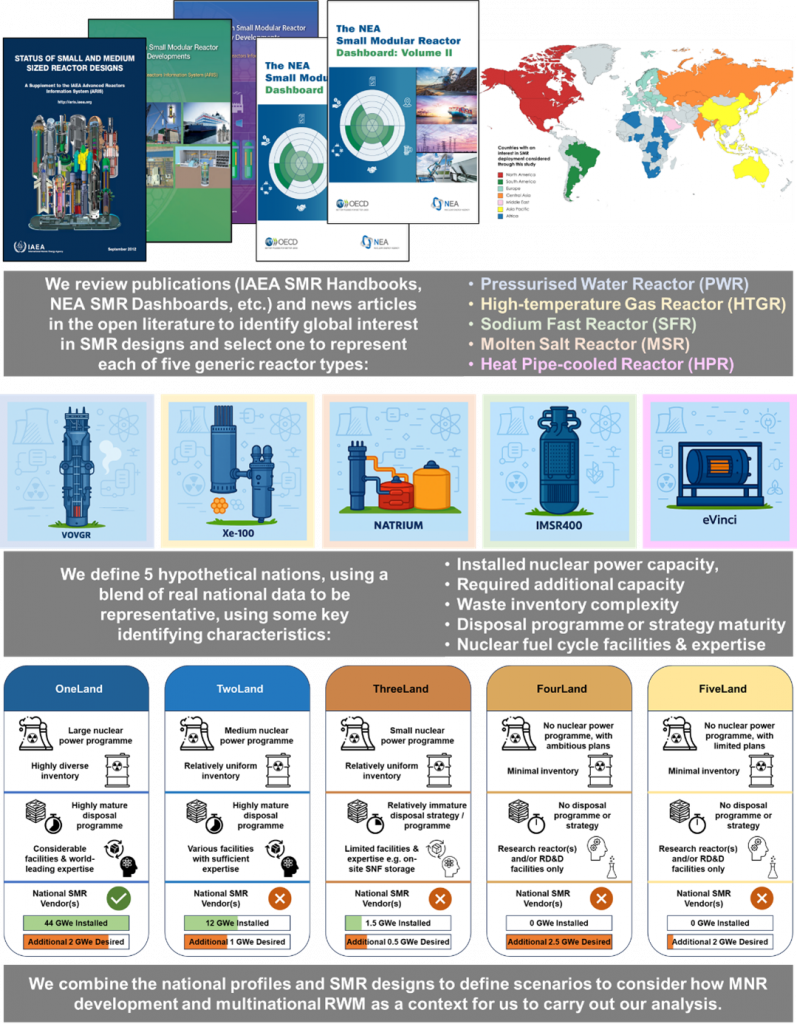
We defined varied MNR models and scenarios to explore the potential impact of SMR deployment on the feasibility of a multinational collaborative approach to SNF disposal and upstream enabling activities, assuming an open fuel cycle.
We conclude that widespread deployment of SMRs is likely in the near-term and that SMR deployment is likely to prompt greater interest in MNR initiatives. We compared a partnered approach to MNR development with a more commercial approach: the former is more likely to involve international SMR technology alignment, requiring strategic engagement prior to SMR deployment; and the latter will likely need to factor the acceptance of multiple SNF types into the MNR design process, introducing technical challenges.
The greater number and geographical distribution of reactors resulting from SMR deployment will introduce new logistical RWM challenges and compound SNF security and safeguards concerns. However, we do not necessarily see these as significant blockers to MNR realisation. The key topics we identify as needing further study are the alignment of upstream activities, the scheduling of waste transports, varied regulatory regimes, and the legal status of importing or exporting radioactive waste for disposal. The most effective next step would seem to be through encouraging SMR vendors to develop relationships with potential MNR providers, e.g., ERDO, and/or with national waste management organisations. This is a two-way process, and organisations such as ERDO should also be promoting discussions with SMR vendors. The overarching issue is that of MNR credibility: SMR vendors are only likely to expend resources on pursuing this approach should concrete MNR commitments surface.
Our published report was developed throughout 2023 and 2024 and brings together two topics which have both seen accelerating developments and increasing attention in this time: both SMRs and MNRs. The publication is a development of that which we had the opportunity to share at the IAEA Spent Fuel Management conference in June 2024 and the 10th IGD-TP Exchange Forum in November 2025.